
MITSDE Career Accelerator Program in


The AI-Enabled Lean Six Sigma Green Belt Training & Certification course is an advanced intermediate-level program that combines the proven Lean Six Sigma methodology with the power of Artificial Intelligence (AI) to drive smarter, faster, and more effective process improvements.
The course provides comprehensive knowledge of Lean Six Sigma principles, the DMAIC methodology, statistical analysis, and industry-standard quality tools while introducing AI-powered techniques for data analysis, root cause identification, process optimization, predictive insights, and decision-making.
Participants will develop the skills to lead improvement projects, analyze complex business data, eliminate waste, reduce process variation, and implement sustainable solutions using both Lean Six Sigma and AI-enabled tools. The program also equips professionals to leverage AI for enhanced productivity, automation, and continuous improvement across manufacturing, service, healthcare, IT, and other industries.
Upon successful completion, participants will be prepared to lead cross-functional improvement initiatives under the guidance of Lean Six Sigma Black Belts or Master Black Belts while applying AI-driven approaches to solve real-world business challenges and accelerate organizational excellence.
Asian Institute of Quality Management is accredited institute by The Council for Six Sigma Certification (CSSC-USA). The CSSC accreditation reflects global standards of excellence in Lean Six Sigma education. This internationally recognized credential validates your knowledge, strengthens your professional credibility, and enhances your career opportunities across industries. Employers worldwide value CSSC certification as a benchmark of quality, competence, and practical problem-solving expertise. Earn a certification that is respected globally and recognized for its commitment to operational excellence.
In today's rapidly evolving business environment, organizations are seeking professionals who can combine process improvement expertise with the power of Artificial Intelligence to drive operational excellence. This course equips you with the knowledge, tools, and practical skills to solve business problems more efficiently and make data-driven decisions.
By enrolling in this program, you will:
| SR No. | Topic |
|---|---|
| 1 | Quality Defined – VOC, CTQ, KANO Model. |
| 2 | The Process Approach: CTPS |
| Improving Effectiveness & Efficiency of Processes | |
| 3 | Evolution of the Quality Function |
| Appraisal & Prevention in Processes using ICD & RCO Preventions | |
| Root Cause Analysis (RCA) | |
| Correction, Corrective Action, Preventive Action | |
| Goals of Lean Six Sigma | |
| Team Formation for Lean Six Sigma Projects – Implementation | |
| Selecting Organization's Pain areas for implementing Lean Six Sigma Projects | |
| 4 | Cross-Functional Cooperation / Boundary-less Collaboration |
| Route for achievement of QCD Goals to deliver VALUE to organization | |
| 5 | The Process Approach: CTPS |
| Improving Effectiveness & Efficiency of Processes | |
| 6 | DPU & DPMO – Calculating Process Capability |
| 7 | Cost of Quality – Impacting On Sigma Level Of A Process |
| Phil Crosby's Findings | |
| 8 | Motorola's journey from 3.4 to 6.0 sigma |
| 9 | Lean Six Sigma – basic principles |
| Cultural changes required while implementing Lean Six Sigma | |
| 10 | Importance of studying variation in Lean Six Sigma |
| Introduction to Descriptive Statistics | |
| Central Tendency (mean – median - mode) | |
| Spread (range – standard deviation) | |
| Use of Excel 'data analysis' tools for descriptive statistics | |
| Interpreting presence of Assignable cause variation and Non-Assignable cause | |
| Variation in processes using descriptive statistics | |
| 11 | Seven tools of quality: |
| 1. Flowchart / Process map | |
| 2. Check-sheet | |
| 3. Pareto Chart | |
| 4. Histogram | |
| 5. Fishbone | |
| 6. Scatter Plot / Correlation Coefficient | |
| 7. Control Charts | |
| Quantitative exercises using excel data analytics. | |
| 12 | Use of SPC (Statistical Process Control) |
| Calculating Process Capability Cp, Cpk | |
| Breakthrough Improvement and Continual Improvement | |
| Exercises linked to above concepts | |
| 13 | Seven types of Control Charts and their interpretation |
| Exercises linked to above charts | |
| 14 | DMAIC METHODOLOGY for Implementing Lean Six Sigma Projects To Achieve Process Excellence. |
| D - Define Phase | |
| M - Measure Phase | |
| A - Analyze Phase | |
| I - Improve Phase | |
| C - Control Phase | |
| DMAIC CASE STUDY - Defect reduction | |
| 15 | Failure Mode & Effect Analysis (FMEA) |
| 16 | Use of Lean Tools in Lean Six Sigma |
| 17 | Value Stream Process Mapping |
| 18 | AI applications in Six Sigma - Use cases |

International Trainer & Consultant for Lean Six Sigma, Kaizen-Lean Management, 3P Events, TQM, TPM, Manufacturing Excellence, Project Management, Business Analytics, SPC, KPI Management, 5 Core Tools Business Strategy, Certifications for implementation and auditing of various ISO Management Systems, Improving Personal & Professional Productivity. Read More

Mrs. Kawaljit Singh is an IT professional with over 37 years' work experience in the field of Quality Management and Manufacturing / Operational Excellence working with a variety of industries in the manufacturing and services sectors. Read More
Lean Six Sigma Green Belt is a professional program that develops management abilities in process improvement, waste reduction, data-driven problem-solving, quality improvement, and operational excellence using Lean Six Sigma methodologies.
The program is ideal for professionals involved in Supply Chain Management (SCM), Procurement, Material Management, Logistics, Warehouse & Inventory, Operations, Quality, and Project Management. It is suitable for professionals looking to reduce waste, optimise inventory, improve material flow, reduce lead time and costs, and lead Lean Six Sigma improvement projects.
The methodology can be applied across any industry, including manufacturing, automotive, healthcare, IT, BFSI, pharmaceuticals, retail, logistics, and service sectors.
AIQM is accredited by the Council for Six Sigma Certification (CSSC), USA, one of the largest accreditation bodies across the globe. This accreditation strengthens the credibility and global recognition of the certifications offered by AIQM.
Lean Six Sigma certifications offered by AIQM are globally recognized and lifetime valid, providing professionals with a valuable credential that remains valid throughout their careers.
The Lean Six Sigma Green Belt Program is open to final-year graduation students, MBA students, BA/BComs/BTechs and working professionals from any industry. It is especially beneficial for professionals working in Supply Chain, Procurement, Project Management, Logistics, Quality, Operations, Manufacturing, and other functional domains.
The course is suitable for both freshers and experienced professionals who want to develop management skills in process improvement, problem-solving, and operational excellence and build a great career.
The program primarily follows the DMAIC methodology – Define, Measure, Analyze, Improve, and Control, along with Lean principles and process improvement tools to implement Lean Six Sigma Green Belt projects in business scenarios.
No. Participants can join the program without prior Green Belt-level knowledge. The course is designed to build understanding progressively from Lean Six Sigma fundamentals to practical application.
Our trainers use simple language and practical examples for faster understanding.
Yes. Lean Six Sigma can be applied across manufacturing, IT, healthcare, banking, finance, BPO/KPO, logistics, supply chain, education, retail, and service industries. The methodology focuses on improving processes, regardless of industry.
The program helps professionals develop structured problem-solving, analytical thinking, process improvement, project management, waste reduction, quality improvement, and data-driven decision-making skills and rise fast in their career.
Management and IT professionals are seen to benefit greatly in career growth with knowledge of Lean Six Sigma.
The training will be conducted on weekends and will consist of evening classes from 6:00 PM to 9:30 PM. The training duration of the course is 28 hours + Home assignments. The training will be spread over 4 weekends.
The trainings will be recorded and uploaded to the LMS account. The recordings can be accessed for 2 months through your LMS account.
The candidate must successfully complete the examination with a minimum score of 50% to qualify for the exam and receive the certification.
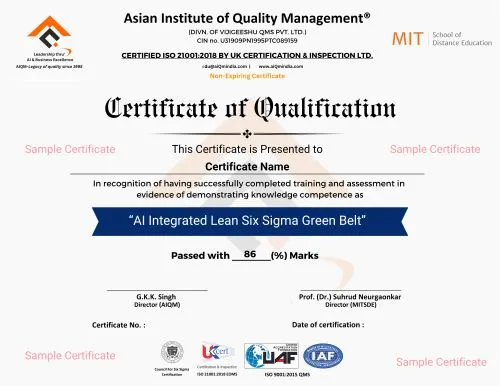
Yes, the soft copy of the Qualification Certificate will be sent to the candidate's registered email address. The hard copy of the certificate will be delivered to the candidate's registered address within India by speed post.
The certifications issued by AIQM are accredited by the Council for Six Sigma Certification (CSSC-USA) and the certificate is valid internationally with lifetime validity. The certificate can be validated/verified on the international IROEP portal.
Absolutely. Lean Six Sigma Green Belt skills can be applied to quality improvement, productivity improvement, cost reduction, process optimization, customer experience, defect reduction, cycle-time reduction, and operational excellence projects within your organization.
AIQM, established in 1995, is a trusted institute for Quality and Operational Excellence, delivering programs across 14+ countries. AIQM is accredited by CSSC-USA and focuses on practical, industry-oriented Lean Six Sigma implementation across Manufacturing, Supply Chain, Logistics, Quality, Projects, Services, and other industries.
AIQM is managed by IIT/IIM alumni and supported by experienced industry professionals. AIQM has supported numerous organisations in implementing Operational Excellence and Lean Six Sigma projects, helping them improve quality, productivity, cost, delivery, and overall process efficiency.
AIQM's trainers bring 30+ years of real-time experience in training, consulting, and project implementation, combining deep industry knowledge with practical hands-on expertise to help participants effectively apply Lean Six Sigma and Operational Excellence methodologies in their organizations.